You are reading a verse. One sentence will not let you go.
Understand the passage you are stuck on.
And see where it stays open.
Next to the Bible text sits an explanation: what is happening, who is speaking, and how the sentence connects with the verses before and after it. Where more than one reading is possible, it says so. Made for readers who compare translations, open a commentary, and still get stuck on the passage.
Not yet released · Mac first · planned: around €10 / month
A fluent answer is not yet an explanation.
Look the passage up somewhere, and you quickly get a smooth paragraph. Whether it is right, you cannot tell by looking at it. An explanation that gets you further does three things:
It says what the text says
Not what people tend to say about the passage, but what the sentence itself states, and which word it hinges on.
It places the context
Who is speaking, what happened before, what the next verse responds to. Many passages clear up through that alone.
It says where it stays open
When more than one reading is possible, it names them instead of presenting one interpretation as the only one. That is the part that is usually missing.
For two thousand years people have wrestled with these sentences.
You are not starting from zero.
Mark 6:5: “He could do no mighty work there.”
A sentence that makes many readers pause: Jesus cannot? This is the explanation Phaneia shows next to the verse, captured in the German test build. The app is available in English and German and answers in the language you run it in.
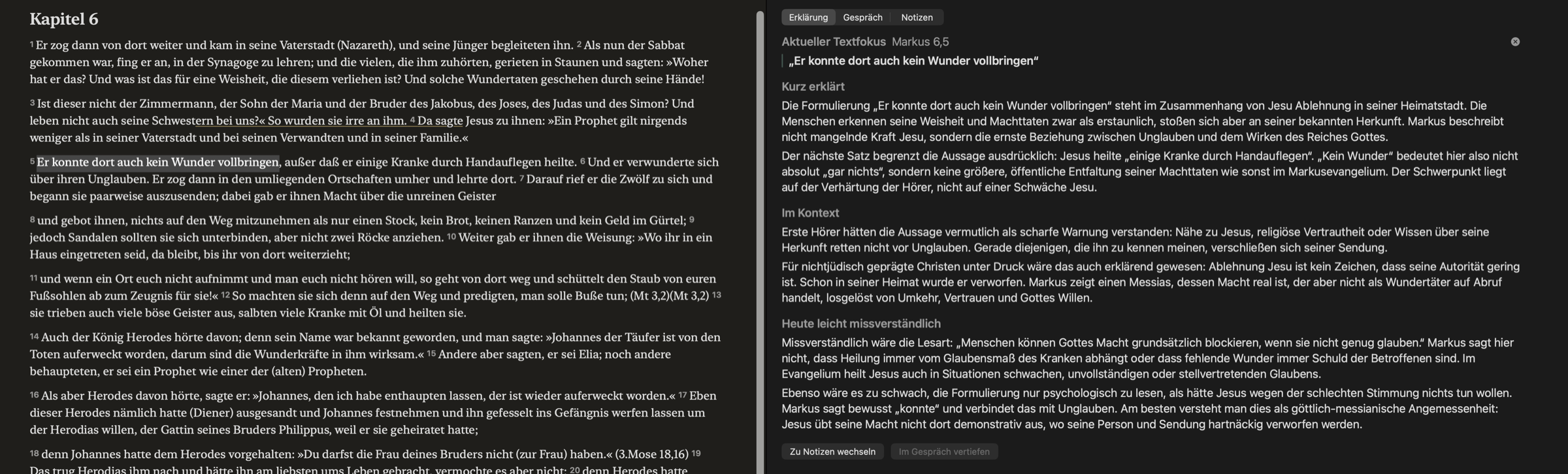
Enlarge the view · captured in the test build, 13 June 2026 · German Menge Bible
The next verse narrows the sentence down
Jesus heals “a few sick people” in Nazareth. So “no mighty work” here does not mean “nothing at all”, but: no public act of power like elsewhere in Mark’s Gospel.
It is about rejection, not weakness
His hometown takes offense at Jesus. Mark shows a power that is real but does not work on demand, detached from repentance and trust.
The explanation names the obvious misreading
“People can block God’s power” is not what the text says. The explanation addresses that directly.
The full question, with the Greek wording and the parallel in Matthew, is available in German: Why could Jesus do no miracles in Nazareth? →
Choose a passage. Tap Explain.
Ask further if you like.
Phaneia is a calm Bible reading app for the Mac; the iPhone follows. The explanation appears next to the text, so you never leave the page.
Choose a passage
Read in the World English Bible, the German Menge Bible, or an EPUB edition you import. One tap on the verse is enough.
Tap Explain
Next to the text sits the explanation: in short, in context, and with a note on where the passage is easily misread today.
Ask further
If the explanation raises a new question, you ask on in the conversation. Unfamiliar terms and people are introduced.
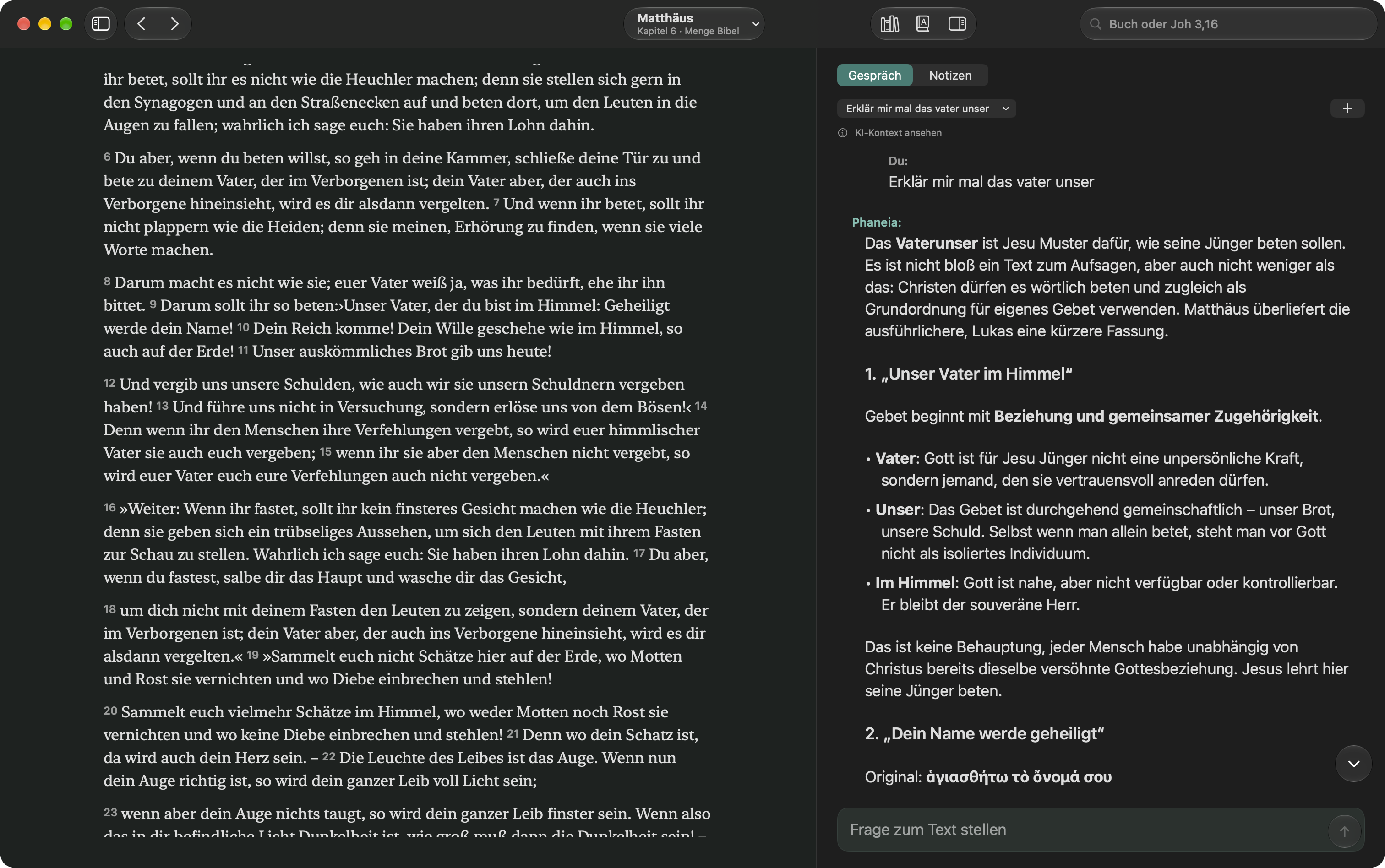
Enlarge the app view · captured 13 September 2026
Sample conversation · Read the full explanation of faith (in German) →
Familiar words.
In the Bible they often mean more.
Sometimes a familiar sentence only makes sense once you know the story behind it. 23 terms and questions, free to read in German →
Glory
In everyday usebeautiful, splendid, radiant.
With MosesMoses asks to see God’s glory. God answers with his presence and goodness.
What becomes clearerGlory describes God’s recognizable greatness. Radiance can be part of it; a beautiful appearance alone is not enough as an explanation.
Holy
In everyday useespecially pious or morally flawless.
At the burning bushGod calls a piece of ground holy because he meets Moses there.
What becomes clearerPlaces and things can be holy too: they belong to God in a special way. For people, that belonging is meant to shape how they act.
Kingdom of God
In everyday usea country, or heaven after death.
With JesusJesus sets people free and says: the kingdom of God has come to you.
What becomes clearerGod’s saving reign begins now. Its final breakthrough, without death and injustice, is still awaited.
You no longer get stuck.
Three things you will notice the next time you read:
Reading on instead of giving up
The explanation sits next to the text before you skip the passage. Unfamiliar names are introduced, and you can follow a Hebrew or Greek word without knowing the language.
Checking instead of accepting
Every explanation names Bible passages and reasons and separates observation of the text from interpretation and open questions. You see what an answer rests on.
What dawns on you stays
Highlighted verses glow gold, thoughts land in the notebook, terms in your word store. Everything lives locally on your devices; your private iCloud keeps them in sync.
Between reading and understanding there is often just one moment.
“I’m Robert, and I’m building Phaneia on my own – with no publisher and no church telling me what goes into the explanations. It began with a simple frustration: while reading, I wanted to follow what is in the text and its context without digging through ten commentaries. Phaneia is the attempt to make exactly that moment calm – and honest, even where the meaning stays open.”
Robert · building Phaneia
Where the explanations come from
Phaneia uses AI. Your question and the context shown go through the Phaneia service to Anthropic. AI can make mistakes. That is why every explanation names the passages and reasons you can check it against, and keeps observation, interpretation and open questions apart.
What happens to your data
Bible text, notes and study data live locally on your devices and can sync through your private iCloud. Your notebook and word notes are not sent automatically. You do not need an account; the subscription runs through your Apple ID.
Planned: around €10 a month.
The difference from a shelf of commentaries: the explanation sits next to the verse, in the moment you are stuck, and tells you what stays open. For that you read and highlight, call up explanations and ask further in the conversation. AI answers come only with this subscription; there is no free tier. Reading, highlighting and your own notes work without a subscription. Your notes stay on your devices and in your private iCloud, and they belong to you.
Try Phaneia
before it is released.
The plan is around €10 a month; AI answers come only with the subscription, and you do not need an account. If Phaneia is an option for you on those terms, join the test group. Joining is free and without obligation. You will first receive an email in which you confirm your signup.
In short.
Who is Phaneia for?
For people who read the Bible themselves and get stuck on individual passages: What does a word mean? Why does Jesus act this way? How do two statements fit together? If you have been comparing translations or working through commentaries for that, you get the explanation right next to the text, together with what stays open.
Can I download Phaneia yet?
Phaneia has not been released. The app is being built for Mac and iPhone; the Mac comes first. Through the free signup you hear when you can try the test build.
What does Phaneia cost?
The plan is around €10 a month. AI answers come only with this subscription; there is no free tier. You do not need an account; the subscription runs through your Apple ID. Reading, highlighting and your own notes work without a subscription. Signing up does not start a subscription.
Which Bible can I read in it?
The World English Bible (WEBP) and the German Menge Bible are included; the Menge Bible is not offered in the US App Store. You can import supported EPUB Bibles yourself. Translations make different choices; Phaneia is meant to help you understand the wording in front of you and difficult passages more precisely. The free learning material on this site is currently in German.
Where do the explanations come from?
Phaneia uses AI for explanations and conversations. They are meant to distinguish observation of the text, interpretation and open questions. AI can make mistakes; a fluent answer is therefore not yet evidence. The passages and reasons given help you check an explanation yourself.
What happens to my texts and questions?
AI explanations and conversations run through the Phaneia service. It passes your question, the context shown, in conversations the earlier messages of that conversation and, when enabled, points from your learning profile to Anthropic. The learning profile is optional: it stores learning points that Phaneia uses to adjust the depth and terms of its explanations. Your notebook and personal word notes are not sent automatically. Text, notes and study data are stored locally and can sync through your private iCloud.
Which passage are you stuck on right now?
Name just the passage or a short question. We store it without an email address and use it only to prioritize the first explanations.